This is a pillar article — the complete reference for coding agent pricing in 2026. Every pricing-related comparison links back here.
Also read: Best coding agents decision guide · Security checklist · Live leaderboard
The Pricing Spectrum
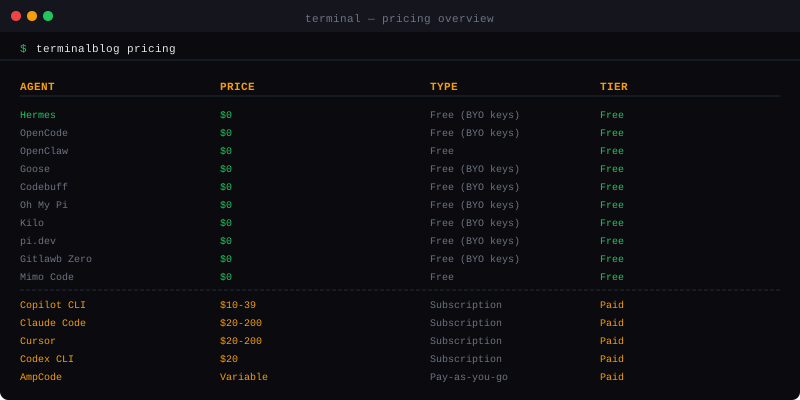 All 15 coding agents ranked by cost — terminalblog.com
| Category | Agents | Monthly Cost |
|---|---|---|
| Free (BYO keys) | Hermes, OpenCode, OpenClaw, Goose, Codebuff, Oh My Pi, Kilo, pi.dev, Gitlawb Zero | $0 + API costs |
| Free (zero cost plus no API) | OpenClaw | $0 |
| Subscription | Claude Code, Cursor, Codex, Copilot CLI | $10-200/month |
| Pay-as-you-go | AmpCode | Variable (~$10/day free tier) |
| Free but commercial | Mimo Code | $0 |
Free Agents (9 agents)
These agents cost nothing to install. You bring your own API keys for the LLM.
Actual cost: $0 for the agent + ~$5-50/month in API usage depending on how much you code.
API Cost Breakdown for Free Agents
When you use a free agent, you’re paying for the LLM API calls. Here’s what that looks like in practice:
Light usage (1-2 hours/day):
- OpenRouter free tier: $0
- Anthropic API (Claude 3.5 Sonnet): ~$10-20/month
- OpenAI API (GPT-4): ~$15-30/month
Heavy usage (4+ hours/day):
- OpenRouter paid: ~$20-50/month
- Anthropic API: ~$40-100/month
- OpenAI API: ~$50-120/month
Cost optimization tips:
- Use OpenRouter’s free models for simple tasks
- Switch to paid models only for complex reasoning
- Set token limits to prevent runaway costs
- Use context caching to reduce redundant API calls
Subscription Agents
| Agent | Monthly | Annual | What you get |
|---|---|---|---|
| Claude Code | $20-200 | $200-2,000 | Deep reasoning, subagents, skills |
| Cursor | $20-200 | $200-2,000 | Fast editing, composer, background agents |
| Codex CLI | $20 (ChatGPT Plus) | $240 | Parallel cloud execution |
| Copilot CLI | $10-39 | $100-468 | GitHub integration, multi-model |
What You’re Actually Paying For
Claude Code ($20-200/month):
- $20 tier: Basic access, limited context window
- $100 tier: Full context, subagents, skills
- $200 tier: Priority access, longer context, custom tools
- Best for: Complex reasoning, multi-file refactors, architecture decisions
Cursor ($20-200/month):
- $20 tier: Basic editing, limited completions
- $100 tier: Full composer, background agents
- $200 tier: Priority model access, custom rules
- Best for: Fast editing, UI work, rapid prototyping
Codex CLI ($20/month):
- ChatGPT Plus subscription required
- Parallel execution in cloud sandbox
- Best for: Batch processing, CI/CD integration, automated testing
Copilot CLI ($10-39/month):
- $10: Basic completions
- $39: Advanced models, custom instructions
- Best for: GitHub-centric workflows, code review, PR automation
Key comparison: Claude Code vs Cursor · Codex vs Copilot CLI
Pay-As-You-Go
| Agent | Free Tier | Paid Tier | Risk |
|---|---|---|---|
| AmpCode | ~$10/day credits | Variable | Costs can spike |
AmpCode Pricing Deep Dive
AmpCode uses a credit system:
- Free tier: ~$10/day in credits (enough for 2-3 hours of coding)
- Paid tier: Variable based on usage
- Risk: Complex tasks can burn credits fast
- Best for: Occasional use, trying out before committing
Cost comparison: If you code 4 hours/day, AmpCode costs ~$200-300/month vs $20/month for a subscription.
Key comparison: AmpCode vs Copilot CLI
The Hidden Costs
- API tokens — Free agents still need LLM access
- Context window waste — Failed tasks burn tokens
- Multi-agent sprawl — Two subscriptions × multiple tools
- Overage charges — Usage-based billing beyond the base plan
Real-World Cost Examples
Developer A (light user):
- 1 hour/day coding with agent
- Uses free agent + OpenRouter free tier
- Total cost: $0/month
Developer B (moderate user):
- 3 hours/day coding with agent
- Uses Claude Code $20 tier + occasional API calls
- Total cost: $20-30/month
Developer C (heavy user):
- 6+ hours/day coding with agent
- Uses Claude Code $100 tier + Cursor $100 tier
- Total cost: $200/month
Developer D (team lead):
- 8+ hours/day, multiple projects
- Uses Claude Code $200 tier + Cursor $200 tier + Codex CLI
- Total cost: $400+/month
ROI Calculation
Time savings: Coding agents typically save 30-50% of coding time.
Example:
- Senior developer: $100/hour
- 4 hours/day coding = $400/day
- 30% time savings = $120/day saved
- Monthly savings: ~$2,400 (20 working days)
- Even at $400/month for agents, that’s 6x ROI
Break-even point:
- Free agents: Immediate ROI
- $20/month subscription: Break-even at 1 hour saved
- $200/month subscription: Break-even at 2 hours saved
Recommendations by Use Case
Solo developer, budget-conscious:
- Start with: Free agent (Hermes or OpenCode) + OpenRouter free tier
- Upgrade to: $20/month subscription when you hit limits
- Avoid: Pay-as-you-go (costs add up fast)
Startup, small team:
- Start with: Claude Code $20 tier for lead developer
- Standardize on: One subscription agent for consistency
- Avoid: Multiple subscriptions (context switching kills productivity)
Enterprise, compliance-heavy:
- Start with: Self-hosted agents (Hermes, OpenCode)
- Add: Subscription agents for specific use cases
- Avoid: Pay-as-you-go (budget unpredictability)
Student/hobbyist:
- Start with: Free agents + free API tiers
- Maximize: OpenRouter free models, community resources
- Avoid: Paid subscriptions (budget for learning, not tools)
Cost analysis & 2026 pricing changes
Pricing is the fastest-moving number on this site. The sticker prices above go stale; these are the dedicated cost-reporting and cost-watch posts to keep instead of guessing:
- The real cost of AI coding agents — what the sticker price hides
- What 8 coding agents cost per month — a side-by-side monthly ledger
- What developers say about coding agent pricing — community-reported bills
- The pricing problem nobody talks about — overhead and hidden fees
- Codex cloud execution economics — when cloud parallelism is worth the bill
- Claude Code vs OpenCode: token overhead — the real per-task cost difference between harnesses
- Kimi K2.7 + Copilot: the open-weight price rebellion — cheaper open weights reset the pricing floor
Recent pricing announcements worth flagging because they moved the numbers in the tables above:
- OpenAI resets ChatGPT/Codex limits with GPT-5.6 (R4) — more parallel codex cloud time for the same $20
- Claude Code 50% weekly limit promotion — more work per $20 Pro seat
- Meta Muse Spark 1.1 API: 25% price cut and the full Spark 1.1 pricing breakdown
- Grok goes free for X users — a real $0 option for browser-based coding
Money rule: subscribe to the cheapest tier that covers your weekly peak, measure token burn with a usage CLI, and re-check this section monthly. Never pay for multi-agent sprawl you aren’t using.
Cost-per-task benchmarks (how to actually predict your bill)
Sticker prices are the easy part. The real bill is tokens, and the only way to predict it is per-task. These are realistic 2026 numbers from our cost-tracking coverage (Oh My Pi usage reporting, Codex cloud economics):
| Task | Tokens | ~API cost (Claude Sonnet-tier) |
|---|---|---|
| One-file bug fix | 20–40K | $0.10–0.30 |
| Feature across 5–10 files | 100–200K | $1–3 |
| Refactor + full test suite | 300–600K | $5–12 |
| Long agentic session (tool loops) | 1–3M | $10–40 |
Multiply by your weekly session count and you get a real monthly number — the one most people skip, and the one that explains why a “free” agent still shows up on a credit-card statement. Token overhead differences between harnesses can double or halve these figures, so measure your own with a usage CLI instead of trusting this table.
Budget templates for 2026
- Hobbyist ($0–10/mo): free BYO agent + free-tier model + one API key; set a hard token cap and a monthly spend alert. See the free-agent options.
- Solo professional ($20–60/mo): one $20 subscription (Claude Code or Cursor) plus a BYO agent for overflow; stop at one subscription — the pricing problem post explains why sprawl is the hidden tax.
- Team ($30–80/seat/mo): standardize on one subscription for consistency; add a second tool only for automation (e.g. a cron-capable free agent). One subscription per seat is the rule.
- Enterprise ($50–200/seat/mo): self-hosted/local agents for the sensitive repos + managed subscriptions for velocity; negotiate annual pricing at 20+ seats.
The what developers say about coding agent pricing thread shows most teams end up in the middle: one subscription, one BYO agent, and one automation twin. That convergence is a signal, not an accident — it is the shape that actually fits a work week.
Verdict
Free agents win on cost. Subscription agents win on polish and benchmark scores. Most developers end up with one of each.
The best strategy:
- Start free to learn what you need
- Add one subscription when you hit limits
- Avoid multi-agent sprawl (pick one primary tool)
- Reevaluate quarterly as pricing changes
See the Complete Guide to AI Coding Agents for the full picture, or Open Source vs Commercial for the OSS perspective.
Your coding agent already makes you faster. aiFiesta makes your AI tools cheaper — $12/mo for 9+ premium models instead of $20/mo each for separate subscriptions.